Wednesday, September 15, 2010

"Drowning in possibility"

Today, I return to one of my earlier themes on this blog, neuroscience.
I just read another of Jonah Lehrer's postings on his blog, Frontal Cortex. He asks, are distractible people more creative? As someone who is definitely both easily distracted and creative, I'd have to say yes.Others may beg to differ.
I love the quotation Lehrer takes from that great melancholy Dane, Soren Kierkegaard (author of such laugh fests as Sickness Unto Death, which I had to read in Philosophy class), undoubtedly referring to (what else?) the downside of multiple options: "Drowning in possibility."
When the mind is alert enough to pull in sights, sounds, smells, scraps of conversation, odd juxtapositions, interesting coincidences and the like, it feels like a huge gift from the universe. Poetry and other kinds of leaps of faith will arise from the synthesis of the right things rushing in together at the right time. It's a heady experience. No wonder many creative people say they feel like idle observers in the creative process: it's as if they hardly have to do any work at all to get something golden. (That's an illusion, of course. Everything involves hard work at some point - 99% perspiration, right?)
However, all that sensation rushing in can cause a log jam. That's why we need discipline, guidance from the Master, and so on. The selection process (instinct, carefully employed memory, experience, education) has to work, otherwise what occurs is far worse than an embarrassment of riches. It may bring creativity to a complete stop. (Been there, done that.)
The modern world provides access to millions of data to anyone with a computer. And yet a distractible person can be overloaded even while walking down the street. In the extreme, of course, it's mental illness.
No wonder we think there's a thin line between genius and madness. Creative people walk that line almost all the time.

Monday, September 13, 2010

Gardening as Metaphor

After this morning's rain, a cleansing wind swept in and opened the clouds. I finished reading a very good book - Allegra Goodman's latest, The Cookbook Collector - and headed to my community garden plot as the sun beamed down.
For a variety of reasons, one of them a kind of benign neglect, I have been allowing my little plot to do its own thing. Being the end of the summer, and not the middle, members of the Compositae Family tend to be most visible. Many species of sunflowers, asters, and goldenrod appear everywhere in the Eastern forest zone. The predominance of yellow hues really brings to mind light and flames. How fitting!
However, it's an embarrassment of riches. My plot is tiny, so a large Rudbeckia plant (pictured) and several Jerusalem Artichoke/sunchoke plants (Helianthus tuberosum L.) took over. My carrots, new arugula and sorrel were all overshadowed by the towering stems and foliage.
Today, since the sunchokes had stopped flowering, I felt I had permission to yank them from the soil. I pulled up about 10 plants in all, and harvested the potato-like tubers. The stems and spent flowers all went into the compost pile. Their day in the sun was over. To everything a season!
I certainly opened up the plot to what's left of the year's useful sunshine. My undernourished leaf and root crops might have a chance now.
According to Kahlil Gibran (if I recall my adolescent reading of The Prophet), "love will be your growth, but it will also be your pruning." Indeed, a very close connection to another person can lop off the odd "dead branch," much like on an old rose bush, allowing us to grow better. (I'm thinking of the loss of bad habits and routines, and openness to new plans.) Gibran also might have meant weeding the garden of the soul. Love forces us to re-evaluate ourselves by changing our surroundings like the shifting seasons; things we took for granted no longer apply, at least not in the same way. It may be comforting to cling to old ways of thinking, and allow the status quo to continue without question. However, well-timed change can do wonders.
Not too late to let in more light. In my garden, at least six weeks remain for the greens to catch up, and I may have a nice salad to go with some delicious sunchoke fritters in October.

Friday, August 20, 2010

The Middle Way

I was at a wedding last week-end. The bride and groom are young - mid-20s - and full of more positive emotions than you'd expect in the average newlyweds. They have very good emotional intelligence - something more useful in navigating life's ups and downs than basic I.Q., according to several studies I've seen. That ability to roll with the punches and stay positive can pull a person through rough patches, and make the smooth patches more likely!
A wedding is about many things, including the future - which we tend to associate with looking up. (The Chinese character for "tomorrow" means literally "bright day.") We enjoy attending weddings because of the amazing energy given off by the couple at the centre of their family, friends, and community. Celebration and exultation feel good - everyone knows that.
The opposites, mourning and despair, feel bad. Most people try to avoid them at all costs (even if the experience of very low mood can bring new insights and depth). However, almost no one tries to avoid exultation. It's wonderful to feel high on love or joy or pride - what possible downside could there be?
Buddhists advise the Middle Way: neither extreme joy nor extreme sorrow. Extremes tend to distort thinking, and place too much focus on the self (which is supposed to be "forgotten" in the scheme of things). Balance is key.
Dancing with a large group of people to very joyous music (see photo) - in fact, most fast dancing - brings about changes that easily veer into exultation, even ecstasy (removal of the self). An experience like that is too be savored, but in moderation. Too much joy, like too much sorrow, interferes with attention. And attention is a crucial aspect of dealing with life - through all its inevitable ups and downs.

Tuesday, August 10, 2010

The Consumer Disconnect

I'm back - but not from a vacation in the usual sense. I have been in town the whole time, but enjoying a break from my routine. It has nothing to do with work (though that has changed to accommodate the "vacation") and everything to do with a rediscovered friend. When two old friends can talk this easily after decades of separation, they can either cry over the lost years, or celebrate the reconnection and hold onto it tightly (this time). So far, my friend and I are doing the latter. Onwards and upwards, time's a'wastin'.
The great wealth to be found in interpersonal connections versus material wealth is evident to any lonely heiress sitting in a penthouse with a silent phone. But that truth is never so strongly felt as when we actually experience that connection ourselves, and realize we wouldn't trade it for the fanciest house or wildest vacation.
I sometimes feel, in this blog and in my day-to-day mutterings, as if I am a broken record, going on and on about friendship, love, attachment, and connection on the one hand, and the fallacy of materialism and the consumer ethic on the other. So it is good to see that I am not alone in my proselytizing. A cultural "meme" may be gaining speed, likely due to economic necessity rather than philosophical enlightenment - but so what? Where you get your epiphany doesn't matter as much as the getting it in the first place.
Check out this NY Times article in the Business section of Sunday's paper. It employs the usual examples of people "downsizing" and simplifying their lives, supplemented by testimony from academics about how true happiness is found in other people and the activities that bring us together (e.g., trips, classes, sports) not in heaps of things.
I look forward to a day when such articles aren't published because, d'uh!, we already know this about our species. Love: great! Stuff: not so important.

Wednesday, July 21, 2010

Thought for the Day

"Until one is committed, there is hesitancy, the chance to draw back ... The moment one definitely commits, then Providence comes too. All sorts of things occur to help one that would never otherwise have occurred ... Whatever you can do or dream, you can begin it. Boldness has genius, power and magic in it. Begin it now."
- Goethe

Tuesday, July 20, 2010

"Home Remedies" for Depression

Sometimes it doesn't matter where an idea comes from, only whether it has value. Intellectual vanity should not be a factor. Good ideas must not wither in the dark.
From time to time, I come up with a clever pun or joke and feel pretty pleased with myself - until someone "steals" it (i.e., comes up with the same idea independently). There goes my unique invention! I am not amused (anymore).
I am a little less annoyed, ironically enough, when one of my theories about this or that is similarly poached by the collective unconscious, so to speak. Having labored in virtual solitude about so many things, I find it gratifying - not to mention a bit flattering - when someone with an academic post or another kind of visibility has the same idea as mine. Whereas many of my thoughts may have almost no chance of being heard (outside of this blog), other people's work may find a much bigger audience. Almost nowhere is this more important than in the realm of public health.
Case in point this morning was an article in the Guardian. Dr. Steve Ilardi, a psychologist at the University of Kansas, has just written a book called The Depression Cure. He argues that medication to beat the blues is largely ineffective. What works, in his opinion (and mine), are lifestyle changes - that conform with our evolutionary past.
"Our standard of living is better now than ever before, but technological progress comes with a dark underbelly. Human beings were not designed for this poorly nourished, sedentary, indoor, sleep-deprived, socially isolated, frenzied pace of life. So depression continues its relentless march."
 Although I have never suffered from clinical depression - that slough of despond into which no one wants to fall - I have been melancholic, low, blue, and even in despair many, many times. I have always resisted medication, primarily because I knew from my teens that if bad feelings can be triggered by certain environmental factors (darkness, isolation, stress), then they can be similarly alleviated by others. Ilardi is saying basically the same thing. Strangely enough, he cites the very things I have been using myself, and counselling others to use: a good diet, rich in omega-3 fatty acids (for the nerve cells, especially in the brain itself); sufficient sleep; the company of good people; satisfying activities for "flow" and just plain distraction from bad thoughts; and outdoor activity (sunshine, exercise).
Sounds simple, doesn't it? Alas, modern life precludes almost all of it! Processed foods are nutritional deserts. Long work days leave little time for fulfilling hobbies or time with people we love - or want to get to know. And city life removes us from nature: the animal spirits and soothing bath of green we evolved to have around us.

Saturday, July 10, 2010

"Community" Garden

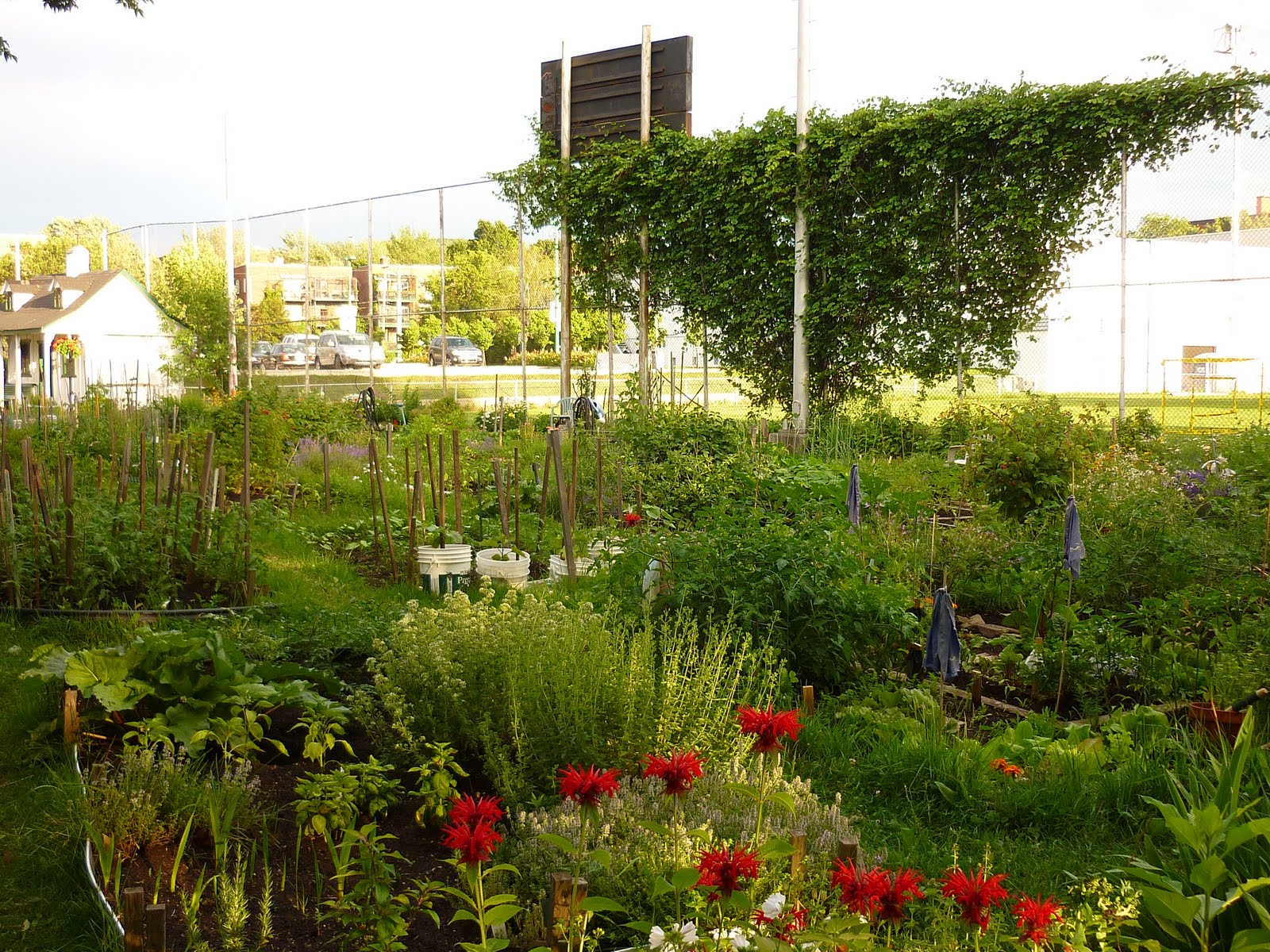
Just this week, I heard something I had been dreading: more evidence that the community garden where I have my little patch of Eden (left) will be erased to make room for condos - large numbers of sterile, green-hating condos.
I have to get my hands on the documents (or the ones allowed into the public eye - I doubt everything will be available, she mutters cynically) before I can do anything, such as draft a protest letter, citing environmental impact, etc. But I am already discouraged by talk (with fellow gardeners) of the strict and blind adherence to ye olde Bottom Line exhibited by the city council. In order to attract more wealthy tax payers to the area, they will wipe out a large area of useful green space (not a vacant lot), and take with it the place where people like me find solace and a bit of actual sustenance, and where many young people congregate to play baseball in the nearby field. That will all be gone next year or the year after. I asked my informant whether there is any chance of swaying the council with an angry protest from the lot of us, and she said that the gardeners and local neighbors (who benefit from green space, and would suffer from increased traffic) are generally resigned to the fact that the council only thinks of money and will not engage in democratic discourse. Defeated before we begin.
Everyone - whether truly busy (see "Insidious Busyness" below) or gifted with ample time, such as many retirees - has been conditioned by big business to be an individual first, and later (if ever) part of a community.
The system is self-perpetuating, even without veering into illegal or unethical behavior. 
What do we do about it?
Stay tuned. I ain't finished with these self-serving, life-negating, community-blind fascists with dollar signs for eyes just yet.