Tuesday, August 10, 2010

The Consumer Disconnect

I'm back - but not from a vacation in the usual sense. I have been in town the whole time, but enjoying a break from my routine. It has nothing to do with work (though that has changed to accommodate the "vacation") and everything to do with a rediscovered friend. When two old friends can talk this easily after decades of separation, they can either cry over the lost years, or celebrate the reconnection and hold onto it tightly (this time). So far, my friend and I are doing the latter. Onwards and upwards, time's a'wastin'.
The great wealth to be found in interpersonal connections versus material wealth is evident to any lonely heiress sitting in a penthouse with a silent phone. But that truth is never so strongly felt as when we actually experience that connection ourselves, and realize we wouldn't trade it for the fanciest house or wildest vacation.
I sometimes feel, in this blog and in my day-to-day mutterings, as if I am a broken record, going on and on about friendship, love, attachment, and connection on the one hand, and the fallacy of materialism and the consumer ethic on the other. So it is good to see that I am not alone in my proselytizing. A cultural "meme" may be gaining speed, likely due to economic necessity rather than philosophical enlightenment - but so what? Where you get your epiphany doesn't matter as much as the getting it in the first place.
Check out this NY Times article in the Business section of Sunday's paper. It employs the usual examples of people "downsizing" and simplifying their lives, supplemented by testimony from academics about how true happiness is found in other people and the activities that bring us together (e.g., trips, classes, sports) not in heaps of things.
I look forward to a day when such articles aren't published because, d'uh!, we already know this about our species. Love: great! Stuff: not so important.

Wednesday, July 21, 2010

Thought for the Day

"Until one is committed, there is hesitancy, the chance to draw back ... The moment one definitely commits, then Providence comes too. All sorts of things occur to help one that would never otherwise have occurred ... Whatever you can do or dream, you can begin it. Boldness has genius, power and magic in it. Begin it now."
- Goethe

Tuesday, July 20, 2010

"Home Remedies" for Depression

Sometimes it doesn't matter where an idea comes from, only whether it has value. Intellectual vanity should not be a factor. Good ideas must not wither in the dark.
From time to time, I come up with a clever pun or joke and feel pretty pleased with myself - until someone "steals" it (i.e., comes up with the same idea independently). There goes my unique invention! I am not amused (anymore).
I am a little less annoyed, ironically enough, when one of my theories about this or that is similarly poached by the collective unconscious, so to speak. Having labored in virtual solitude about so many things, I find it gratifying - not to mention a bit flattering - when someone with an academic post or another kind of visibility has the same idea as mine. Whereas many of my thoughts may have almost no chance of being heard (outside of this blog), other people's work may find a much bigger audience. Almost nowhere is this more important than in the realm of public health.
Case in point this morning was an article in the Guardian. Dr. Steve Ilardi, a psychologist at the University of Kansas, has just written a book called The Depression Cure. He argues that medication to beat the blues is largely ineffective. What works, in his opinion (and mine), are lifestyle changes - that conform with our evolutionary past.
"Our standard of living is better now than ever before, but technological progress comes with a dark underbelly. Human beings were not designed for this poorly nourished, sedentary, indoor, sleep-deprived, socially isolated, frenzied pace of life. So depression continues its relentless march."
 Although I have never suffered from clinical depression - that slough of despond into which no one wants to fall - I have been melancholic, low, blue, and even in despair many, many times. I have always resisted medication, primarily because I knew from my teens that if bad feelings can be triggered by certain environmental factors (darkness, isolation, stress), then they can be similarly alleviated by others. Ilardi is saying basically the same thing. Strangely enough, he cites the very things I have been using myself, and counselling others to use: a good diet, rich in omega-3 fatty acids (for the nerve cells, especially in the brain itself); sufficient sleep; the company of good people; satisfying activities for "flow" and just plain distraction from bad thoughts; and outdoor activity (sunshine, exercise).
Sounds simple, doesn't it? Alas, modern life precludes almost all of it! Processed foods are nutritional deserts. Long work days leave little time for fulfilling hobbies or time with people we love - or want to get to know. And city life removes us from nature: the animal spirits and soothing bath of green we evolved to have around us.

Saturday, July 10, 2010

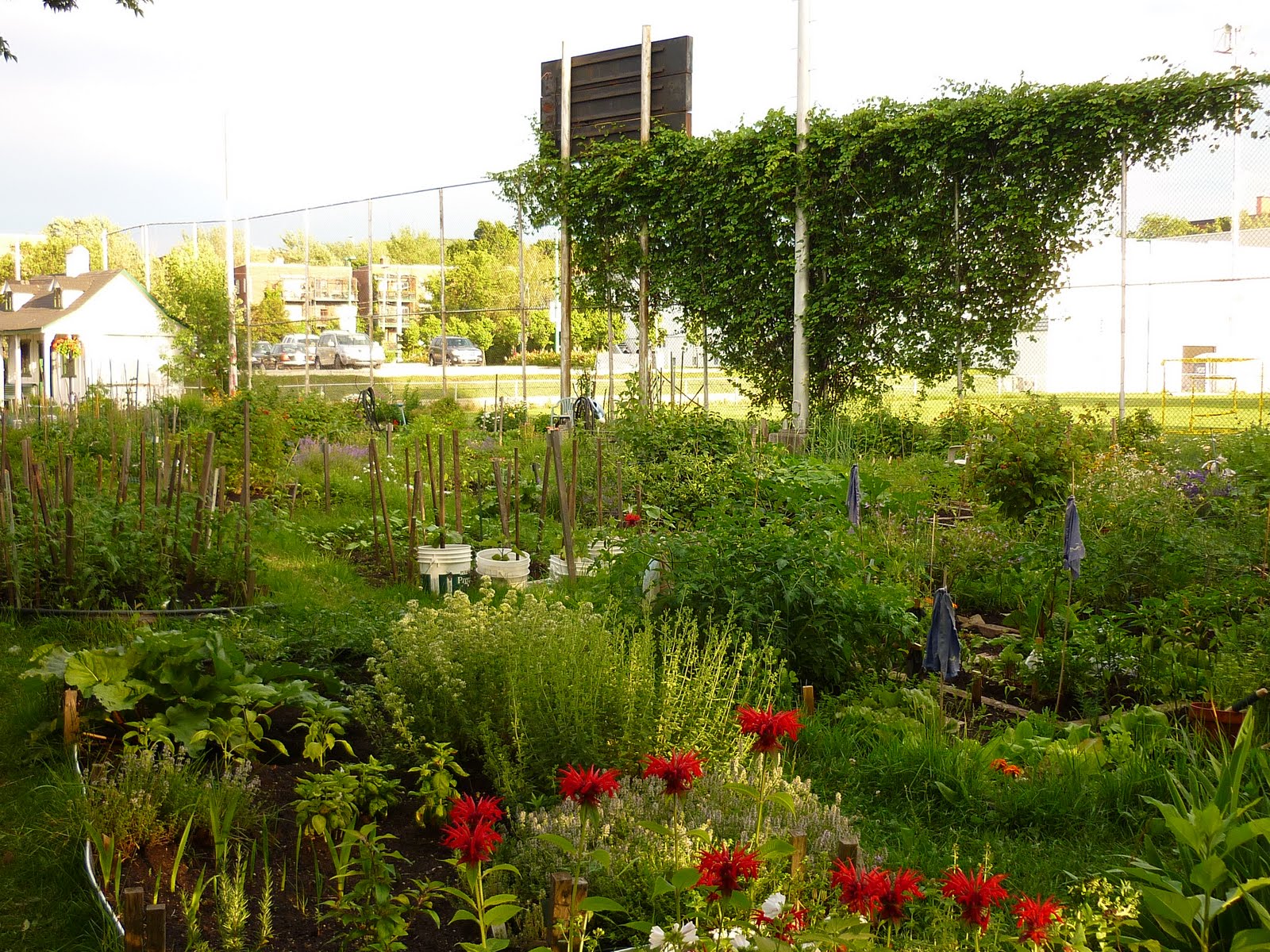
"Community" Garden

Just this week, I heard something I had been dreading: more evidence that the community garden where I have my little patch of Eden (left) will be erased to make room for condos - large numbers of sterile, green-hating condos.
I have to get my hands on the documents (or the ones allowed into the public eye - I doubt everything will be available, she mutters cynically) before I can do anything, such as draft a protest letter, citing environmental impact, etc. But I am already discouraged by talk (with fellow gardeners) of the strict and blind adherence to ye olde Bottom Line exhibited by the city council. In order to attract more wealthy tax payers to the area, they will wipe out a large area of useful green space (not a vacant lot), and take with it the place where people like me find solace and a bit of actual sustenance, and where many young people congregate to play baseball in the nearby field. That will all be gone next year or the year after. I asked my informant whether there is any chance of swaying the council with an angry protest from the lot of us, and she said that the gardeners and local neighbors (who benefit from green space, and would suffer from increased traffic) are generally resigned to the fact that the council only thinks of money and will not engage in democratic discourse. Defeated before we begin.
Everyone - whether truly busy (see "Insidious Busyness" below) or gifted with ample time, such as many retirees - has been conditioned by big business to be an individual first, and later (if ever) part of a community.
The system is self-perpetuating, even without veering into illegal or unethical behavior. 
What do we do about it?
Stay tuned. I ain't finished with these self-serving, life-negating, community-blind fascists with dollar signs for eyes just yet.

Sunday, June 27, 2010

Nostalgia

While cleaning out a closet last week, my mother came upon a cache of my old stuff. I went through a pile of it yesterday, and what stood out most were the letters - about 30 of them, all from the same period in my life.
There was a time when I would have a bundle of letters and postcards (plus copies of some of my own letters) as thick as a loaf of bread by the end of every year. (Now I'm lucky to have three letters per year!) Over maybe 15 years of corresponding with this one or that one, I had an average of five steady correspondents per year. Other people would write only when on vacation, and yet others would drop a line once in a blue moon (and usually, but not always, apologize profusely for the gap). With long-distance rates being so high then, it was the main way to keep in touch over the summer, or after someone moved away.
I have made every effort to save these letters. However, due to many moves, some of these bundles have gone astray. The pile my mother just found was from my teens and early twenties. So the majority of the letters came from classmates between Grade 8 and early university - a very turbulent and highly charged time in anyone's life, let alone that of a sensitive person such as myself or any of the people I tended to hang out with. I was inundated with nostalgia as I read those handwritten letters last night. It was mostly a pleasant experience: happy memories of good people, plus sadness over days gone by. Several things came to mind as I leafed through the pile.
  1. How often, and emotionally, even notoriously taciturn male friends wrote to me! Since some are still in my life to whatever extent is possible (?), I can compare, say, a young Michael or Paul with the middle-aged one. Sad to say, they are very much the same in some respects, but not in an emotionally revealing one. Perhaps life has taught them to be more closed and circumspect.
  2. How valuable a handwritten letter can be - and not just because even the simplest message from a friend says "I'm thinking of you and wish we could be talking in the same room instead." The paper is tangible - a sensual detail. The handwriting reveals character - and you don't have to be trained in graphology to find it useful. The words can also be compared or contrasted with the handwriting - e.g., a cheery letter scribbled in an erratic hand might suggest a friend is hiding anxiety or illness. 
  3. How electronic mail, great boon to keeping in touch across the globe that it is, has all but rendered letter writing obsolete. I feel sorry for the young people who have grown up with instant communication through electronic devices and have few if any records of these often banal but occasionally precious exchanges. And what they do have is printed out from a screen - not scribbled in one friend's fountain pen ink, or another's warm slant (with the drawings of fairies at the bottom of the page presaging her future career as an artist).
To all of you who wrote to me back then - Dale, Belinda, Claude, Paul, Michael, Sandy, Mary, Brad, Lucie, Marie-Hélène, Malcolm, Margaret - thank you for writing to me and doing so with feeling. I am not going to throw out your letters and postcards for a long time, if ever!
Everyone: buy some paper and stamps, and send someone special a short letter! Won't finding a reply in your mailbox be worth a hundred e-mails?
More than ever, it will show you mean to connect, not just pass on information.

Wednesday, June 16, 2010

Why Are Men Smarter than Women?

I was listening to a Guardian podcast on genius when it occurred to me why more men get credited with advancing society, leading most men and lots of women, incidentally, to believe that men are smarter than women. A lot of it has to do with the differences between male brains and female brains, and what society expects of each sex.
(Men also have been doing a very good job of holding back society - through wars, various kinds of harmful dogma, self-serving beliefs and practices - but that's another post perhaps. This "paradox" supports a recent observation that men tend to occupy the extremes of good and bad, while women occupy more of the middle ground.)

Genius is a complex phenomenon, and often identified only in hindsight. A quirky little boy or girl with strange ideas and perspectives will probably be noticed for being different, but not valued for his or her individual outlook unless it yields a discovery, invention, remarkable work of art, or the like. In other words, if you're going to stand out, you have to earn acceptance more than the average person!
Not every genius with the potential for that breakthrough ticket to public acceptance and even adoration finds the right opportunities to shine. We'll never know how many Marie Curies, Isadora Duncans and Virginia Woolfs died in childbirth or toiling in a field - not to mention the Mozarts, Newtons, and Picassos coughing away in attics unable to find the money for basic materials.
To get to that invention or symphony, a person needs talent and opportunity, no doubt about that. But personality - mainly, determination and belief in oneself and one's work - probably separates the sheep from the goats most of all.
That's where male-female brain differences - and how society boldfaces them - come in. Men in general have a greater ability to take a project and focus on it to the exclusion of everything else. The modern cliché of the unkempt computer nerd has historical precedents in the mad scientist or long-haired crazy composer. Men are also more likely to be collectors (another form of monomania). Women are better multitaskers and generalists. While shallow thinking and attention combined with a talent for forming connections can have brilliant results, they do not tend to translate into works of genius. Gregor Mendel grew hundred of pea plants before he was able to discern the patterns of trait inheritance later called genetics. Not only was he incredibly patient and focussed and smart, he was a monk with no other job, no bills to pay, no kids to run after! If a woman did something similar, she'd be called an oddball for opting out of her "true role" as a wife and mother.
If men discover more, change more, it may be because they use their intelligence for deep focus - and tend to find support in family and community for doing so. They also may be more singleminded when it comes to pursuing a socially peripheral project that they alone find worthy; women tend to listen to criticism more.
Things are changing a little. Women with the ability to devote long hours in the lab or at the writing desk are scorned far less than they used to be, and the opportunities needed to advance (money, education, support) are more abundant in many parts of the world. But the female need to form interpersonal connections (and be praised for the ones she does form) may preclude the creation of those really big breakthroughs - the ones that make it into the history books, even if most tend to be written by men.

Sunday, June 13, 2010

Crushed Empathy

Hard to read in parts (I skipped them, I'm not ashamed to admit) but superb and well overdue in a national paper is this New York Times article on the connection between violence towards animals and violent, unempathetic behavior in general.
Finally, forensics labs and law enforcement agencies across the U.S. are making this long-obvious link (what's Canada doing?). Many serial killers were later found to have tortured local pets, and many family abusers have been animal abusers - it's all about a lack of sensitivity to the pain of others, worn down by abuse they endured themselves (directly by adults or by their impoverished and dangerous environment). It is also, of course, about power and control. If you feel the boot-heel of the universe is grinding your face everyday - to paraphrase Orwell - then you will try to hold yourself together by hurting the nearest convenient target: say, a puppy or a toddler. Mental health depends on having a degree of control over one's life. Tragically, violence against weaker beings is the only control available to some people.
Randall Lockwood is at the A.S.P.C.A.'s forensics department.
Along with possible early abuse or genetic and biological components, Lockwood also spoke of the frequent association between environment and acts of violence, how poverty often creates the sense of persecution and injustice that makes some people feel justified in striking back in order to gain the sense of power and control they otherwise lack.  
Nobody in their right mind needs to be told that severe conditions (neglect, abuse, hunger, toxic and understimulating surroundings) tend to give rise to severe children. But it seems to be one of those items of common knowledge that no one wants to admit - if admitting means addressing it and fixing it. It means admitting to horrible living conditions in otherwise rich cities. It means admitting systemic cracks in certain cultures within cultures. For example, many poor boys join gangs because they have no fathers around to give them direction, no job prospects, and often no one to love them or accept them except gang members. But gang membership is a cruel kind of acceptance, involving the crushing of any innate empathy - as empathy is equated with weakness.
The brain is a highly plastic organ, ready to adapt to whatever environment it finds itself in. It doesn't always adapt in a way conducive to the greater good.
No child is an island: whatever stunts his growth, stunts the entire community. And the companion animals we bring into our homes are part of that community, too. We ignore their abuse at their peril and our own.