Saturday, February 15, 2014

I Have Another New Blog

It's good to see that this old blog is still continuing to attract readers after all this time.
I have started another blog, I SEE A RED WORLD AND I WANT TO PAINT IT GREEN, which deals with some of the same topics.
Check it out and leave a comment! I'm always happy to hear from readers, and wish I could have more of a dialogue about certain issues.
http://change-the-world-green.blogspot.ca


Sunday, August 7, 2011

My New Blog

My new blog is about food and the brain - mostly about the connection between our highly variable diet and the evolution of our large, complex brain.
Check it out at http://omnivorebrain.blogspot.com

Thursday, October 28, 2010

The circle

Time for me to close this little experiment, this public song of myself and my ideas. I have to admit being strongly influenced by this season of dormancy and decomposition. I feel a need to acknowledge how many things this year ended - the short time with my dear cat being only one - and, by doing so, opening myself to hope that life will continue to offer me beginnings.
 Autumn is not just about sadness and the foretaste of winter's death-like stillness. Before leaves and other plant matter release their nutrients to the soil, air, and water, they seem to partake of the fourth element: fire. What better way to go than in the blaze of glory, embodying light? It's as if life itself sings out before departing.

Life continues through recycling, but also by metamorphosis: the transformation of one form to another.


So this may not be my last stab at the blog idea. A new one will likely tie into a new project - book research, perhaps, that needs airing and feedback while in progress - or one of the main threads of this first blog. Human evolution and our dietary habits are on the top of my list. Of course, poetry and ecology will run through everything....


Come springtime, who knows what will appear from the awakening soil?

Sunday, October 24, 2010

A challenge or a sign?

I had a talk with an old friend a week ago. The conversation ended up on the subject of "hitting a brick wall." (It is somewhat related to my previous post.)
When you encounter a set-back of some kind - an experimental flaw, a series of obstacles on the path to a goal, or a huge lack of support from all around you as you embark on a new project - do you see that as a challenge to be overcome, or a sign that the matter at hand is not meant to be?
My friend and I only succeeded in parsing out the problem. No easy formula occurred to us for determining which is which. I guess every dilemma has its own unique factors.
I imagine the age you are when you hit the brick wall is quite significant. Young people are inexperienced in most things, so they will find themselves ill-equipped more often than someone older, generally speaking. The brick wall is more likely to be a challenge. Education can overcome it.
They still have to ask if they should continue taking flute lessons or not, try for the football team for the fifteenth time or change to baseball (or no competitive sports at all), stop pining for that girl in biology class and look elsewhere for love, or take the bar exams for the nth time.
As a writer, I have heard many stories of famous books that were rejected by publishers more than 20 times before someone savvy enought to see the genius in the work took it on - making history. Good example, the 1960s travel memoir The Kon Tiki. How did the author keep trying? Did he ever wonder if the constant rejections "proved" it was a dud? Maybe so - but the determination (or benign sort of egotism) made the author go on, ultimately to success.
That difficulty was a challenge.
To someone else, a sign - not to quit her day job. Being a published author didn't seem to be in the cards. (Giving rise to another potential discussion here about "destiny." No ... I won't go there.)
............
On another note: no word from any of you out there. Four more days and I'm out of here, unless I hear otherwise.

Tuesday, October 12, 2010

To Everything, a Season

Many years ago, I had a very good friend who was a Jehovah's Witness. The friendship would not have persisted over more than a decade, starting in our late teens, had M. pushed his beliefs on me. He was very respectful. But I remember one visit when we were in our mid-twenties, when he finally showed me one of his pamphlets. I had a look-through out of curiosity and was appalled. I had never heard of the Rapture - that fundamentalist Christian belief in some sort of global purge and selection of the holy - so the pamphlet was my first taste of the idea that destroying the planet and starting over was a good way to deal with sin (broadly defined). At that very moment, I learned that many people, religious or not, seek to solve a difficult problem by clearing the slate - instead of doggedly working to fix whatever's wrong.The concept of a cleared field or blank sheet of paper or uncluttered desk focusses the mind incredibly. (In the case of the Rapture, we are not supposed to think of all the people who must die horribly in order to leave the planet "clean.")
Since then, I have seen much evidence of this. Of course, stories abound of stubborn/crazy/devoted writers or researchers or explorers. James Joyce took 18 years to write Finnegans Wake. The Australian who discovered Heliobactor pylori, the bacterium that causes stomach ulcers, fought years to convince a whole cadre of medical skeptics that he was right, until his proof became irrefutable, and controversy became accepted dogma. They were ultimately thanked for their informed monomania.
But giving up might be more common - either because of laziness or wisdom. (We can never know how many projects have been ditched prematurely.) To be sure, hard work is, well, hard work - and the easy way out is enticing. However, it can be folly to ignore any number of signals saying, this ain't gonna work, honey, try something else while you still have the strength. Sometimes it's better to clear the slate and start over. It's not weak, it's wise.
The really, really tricky part is to know when you're onto the right thing - and keep fighting for it - and when it's better to quit.
I've been thinking of this all year - for one thing then another. (Why now? Is it correlated with my age?) At stake are time and energy, two very precious commodities. Hope is a basic human feeling, both adaptive and maladaptive. My dilemma: is keeping my hopes alive a help or a hindrance? Am I a dreamer and a fool? Should I face reality (with the facts I have at hand) and get on with the rest of my life, pouring energy into more certain outcomes?
On a related note, this blog is nearing its first anniversary. I have been wondering if I really have more to say on the subject of connection. Also, the almost complete lack of feedback makes me think I'm writing into a void - the reason I was reluctant to start a blog in the first place!
Perhaps the time has come to bring it to an end, and start another, entirely about neuroscience.
If I don't hear any howls of protest by October 28, I'll sign off then.

Sunday, September 26, 2010

Various love states

Not too long ago, someone asked me, “What’s the difference between friendship and [romantic] love?” Hard to say sometimes, especially when everything seems right between two people who hang out together.
Many people still believe that men and women cannot be friends with each other without sex entering the equation sooner or later. While this may be true, I know from personal experience that it may manifest itself as nothing more than perfectly harmless “behind thinking” - acknowledgment that you “could” get together (assuming you’re both heterosexual), but never would in a million years. (If there is more tension and attraction than that, well, things need to be discussed.)
I have felt respect and affection for many male friends, and they for me. The word “love” eventually crept into letters and even declarations after especially good visits. Some of the men involved were attached at the time, others not. But we all knew what the word meant. It made us feel good to hear it. Connected.
That kind of love has plenty in common with the common use (i.e., in a romantic context). Both imply loyalty, emotional intimacy (lots of stories and advice exchanged), affection, delight, and commiseration in times of strife. But in friendship, a line is drawn somehow. There may be physical affection – even without considering the new spin on this called “friends with benefits” – but there is no sense of belonging to each other, of being a self-contained unit, a couple.In neurological terms (can't resist), in friendship there is a brake on the release of oxytocin - and that limits the amount of intense attachment. (Adding "benefits" pushes the envelope.)
Romantic love itself is complex, as most people know by the age of, say, 15. Since it pivots on the couple, the “universe of us,” it is all-enveloping and all-consuming … until it shifts into something else. It either burns itself out, shatters on impact with undeniable and unworkable difficulties, or settles into a quieter but far stronger version of its fiery debut.
People who enter long-term relationships often bewail the settling-down stage, saying “the romance has died.” If they still really enjoy being with each other and have a friendship plus a sense of being a unit, then they are likely uninformed about the nature of human emotions (fireworks don’t last indefinitely!), and should realize how lucky they are. (A total lack of togetherness and pizzazz is another matter altogether, and indicates true trouble.)
The all-consuming stage is the exciting part: exciting like a roller coaster, a combination of near-death terror and out-of-body delight! It is probably nature’s way to get us to mate – always a dangerous enterprise, especially for women – by giving us temporary brain damage. (This may be less a joke than it sounds.) By the time we recover, we are either hip to Sweetie’s faults, or we are bound to him or her for the long haul.
In any case, the bond is what counts, not the brain damage that preceded it (as amazing as that can be).
In some ways, what happens is that a kind of friendship settles in – the best kind of friendship imaginable. You have someone there with whom you can be your truest self, and vice versa. You have shared the most intimate aspects of your mind and body. You look to the same future. You make each other grow through pruning and TLC.
The ancient Greeks saw love as eros, phileo, agape, and storge. Eros is not just sexual love, but the need to see Beauty in another another person. It is a manifestation of the life force. Phileo is love of humanity, generalized or individualized (as in love of a friend). Agape is most interesting: it is proven through selfless action rather than feeling - so is closer to the word "respect." Finally storge is the long-lasting love within a family. 
Clearly, romantic love combines or should combine all of these aspects of human emotion. Is the answer to the question: friendship is everything but eros?

Wednesday, September 15, 2010

"Drowning in possibility"

Today, I return to one of my earlier themes on this blog, neuroscience.
I just read another of Jonah Lehrer's postings on his blog, Frontal Cortex. He asks, are distractible people more creative? As someone who is definitely both easily distracted and creative, I'd have to say yes.Others may beg to differ.
I love the quotation Lehrer takes from that great melancholy Dane, Soren Kierkegaard (author of such laugh fests as Sickness Unto Death, which I had to read in Philosophy class), undoubtedly referring to (what else?) the downside of multiple options: "Drowning in possibility."
When the mind is alert enough to pull in sights, sounds, smells, scraps of conversation, odd juxtapositions, interesting coincidences and the like, it feels like a huge gift from the universe. Poetry and other kinds of leaps of faith will arise from the synthesis of the right things rushing in together at the right time. It's a heady experience. No wonder many creative people say they feel like idle observers in the creative process: it's as if they hardly have to do any work at all to get something golden. (That's an illusion, of course. Everything involves hard work at some point - 99% perspiration, right?)
However, all that sensation rushing in can cause a log jam. That's why we need discipline, guidance from the Master, and so on. The selection process (instinct, carefully employed memory, experience, education) has to work, otherwise what occurs is far worse than an embarrassment of riches. It may bring creativity to a complete stop. (Been there, done that.)
The modern world provides access to millions of data to anyone with a computer. And yet a distractible person can be overloaded even while walking down the street. In the extreme, of course, it's mental illness.
No wonder we think there's a thin line between genius and madness. Creative people walk that line almost all the time.

Monday, September 13, 2010

Gardening as Metaphor

After this morning's rain, a cleansing wind swept in and opened the clouds. I finished reading a very good book - Allegra Goodman's latest, The Cookbook Collector - and headed to my community garden plot as the sun beamed down.
For a variety of reasons, one of them a kind of benign neglect, I have been allowing my little plot to do its own thing. Being the end of the summer, and not the middle, members of the Compositae Family tend to be most visible. Many species of sunflowers, asters, and goldenrod appear everywhere in the Eastern forest zone. The predominance of yellow hues really brings to mind light and flames. How fitting!
However, it's an embarrassment of riches. My plot is tiny, so a large Rudbeckia plant (pictured) and several Jerusalem Artichoke/sunchoke plants (Helianthus tuberosum L.) took over. My carrots, new arugula and sorrel were all overshadowed by the towering stems and foliage.
Today, since the sunchokes had stopped flowering, I felt I had permission to yank them from the soil. I pulled up about 10 plants in all, and harvested the potato-like tubers. The stems and spent flowers all went into the compost pile. Their day in the sun was over. To everything a season!
I certainly opened up the plot to what's left of the year's useful sunshine. My undernourished leaf and root crops might have a chance now.
According to Kahlil Gibran (if I recall my adolescent reading of The Prophet), "love will be your growth, but it will also be your pruning." Indeed, a very close connection to another person can lop off the odd "dead branch," much like on an old rose bush, allowing us to grow better. (I'm thinking of the loss of bad habits and routines, and openness to new plans.) Gibran also might have meant weeding the garden of the soul. Love forces us to re-evaluate ourselves by changing our surroundings like the shifting seasons; things we took for granted no longer apply, at least not in the same way. It may be comforting to cling to old ways of thinking, and allow the status quo to continue without question. However, well-timed change can do wonders.
Not too late to let in more light. In my garden, at least six weeks remain for the greens to catch up, and I may have a nice salad to go with some delicious sunchoke fritters in October.

Friday, August 20, 2010

The Middle Way

I was at a wedding last week-end. The bride and groom are young - mid-20s - and full of more positive emotions than you'd expect in the average newlyweds. They have very good emotional intelligence - something more useful in navigating life's ups and downs than basic I.Q., according to several studies I've seen. That ability to roll with the punches and stay positive can pull a person through rough patches, and make the smooth patches more likely!
A wedding is about many things, including the future - which we tend to associate with looking up. (The Chinese character for "tomorrow" means literally "bright day.") We enjoy attending weddings because of the amazing energy given off by the couple at the centre of their family, friends, and community. Celebration and exultation feel good - everyone knows that.
The opposites, mourning and despair, feel bad. Most people try to avoid them at all costs (even if the experience of very low mood can bring new insights and depth). However, almost no one tries to avoid exultation. It's wonderful to feel high on love or joy or pride - what possible downside could there be?
Buddhists advise the Middle Way: neither extreme joy nor extreme sorrow. Extremes tend to distort thinking, and place too much focus on the self (which is supposed to be "forgotten" in the scheme of things). Balance is key.
Dancing with a large group of people to very joyous music (see photo) - in fact, most fast dancing - brings about changes that easily veer into exultation, even ecstasy (removal of the self). An experience like that is too be savored, but in moderation. Too much joy, like too much sorrow, interferes with attention. And attention is a crucial aspect of dealing with life - through all its inevitable ups and downs.

Tuesday, August 10, 2010

The Consumer Disconnect

I'm back - but not from a vacation in the usual sense. I have been in town the whole time, but enjoying a break from my routine. It has nothing to do with work (though that has changed to accommodate the "vacation") and everything to do with a rediscovered friend. When two old friends can talk this easily after decades of separation, they can either cry over the lost years, or celebrate the reconnection and hold onto it tightly (this time). So far, my friend and I are doing the latter. Onwards and upwards, time's a'wastin'.
The great wealth to be found in interpersonal connections versus material wealth is evident to any lonely heiress sitting in a penthouse with a silent phone. But that truth is never so strongly felt as when we actually experience that connection ourselves, and realize we wouldn't trade it for the fanciest house or wildest vacation.
I sometimes feel, in this blog and in my day-to-day mutterings, as if I am a broken record, going on and on about friendship, love, attachment, and connection on the one hand, and the fallacy of materialism and the consumer ethic on the other. So it is good to see that I am not alone in my proselytizing. A cultural "meme" may be gaining speed, likely due to economic necessity rather than philosophical enlightenment - but so what? Where you get your epiphany doesn't matter as much as the getting it in the first place.
Check out this NY Times article in the Business section of Sunday's paper. It employs the usual examples of people "downsizing" and simplifying their lives, supplemented by testimony from academics about how true happiness is found in other people and the activities that bring us together (e.g., trips, classes, sports) not in heaps of things.
I look forward to a day when such articles aren't published because, d'uh!, we already know this about our species. Love: great! Stuff: not so important.

Wednesday, July 21, 2010

Thought for the Day

"Until one is committed, there is hesitancy, the chance to draw back ... The moment one definitely commits, then Providence comes too. All sorts of things occur to help one that would never otherwise have occurred ... Whatever you can do or dream, you can begin it. Boldness has genius, power and magic in it. Begin it now."
- Goethe

Tuesday, July 20, 2010

"Home Remedies" for Depression

Sometimes it doesn't matter where an idea comes from, only whether it has value. Intellectual vanity should not be a factor. Good ideas must not wither in the dark.
From time to time, I come up with a clever pun or joke and feel pretty pleased with myself - until someone "steals" it (i.e., comes up with the same idea independently). There goes my unique invention! I am not amused (anymore).
I am a little less annoyed, ironically enough, when one of my theories about this or that is similarly poached by the collective unconscious, so to speak. Having labored in virtual solitude about so many things, I find it gratifying - not to mention a bit flattering - when someone with an academic post or another kind of visibility has the same idea as mine. Whereas many of my thoughts may have almost no chance of being heard (outside of this blog), other people's work may find a much bigger audience. Almost nowhere is this more important than in the realm of public health.
Case in point this morning was an article in the Guardian. Dr. Steve Ilardi, a psychologist at the University of Kansas, has just written a book called The Depression Cure. He argues that medication to beat the blues is largely ineffective. What works, in his opinion (and mine), are lifestyle changes - that conform with our evolutionary past.
"Our standard of living is better now than ever before, but technological progress comes with a dark underbelly. Human beings were not designed for this poorly nourished, sedentary, indoor, sleep-deprived, socially isolated, frenzied pace of life. So depression continues its relentless march."
 Although I have never suffered from clinical depression - that slough of despond into which no one wants to fall - I have been melancholic, low, blue, and even in despair many, many times. I have always resisted medication, primarily because I knew from my teens that if bad feelings can be triggered by certain environmental factors (darkness, isolation, stress), then they can be similarly alleviated by others. Ilardi is saying basically the same thing. Strangely enough, he cites the very things I have been using myself, and counselling others to use: a good diet, rich in omega-3 fatty acids (for the nerve cells, especially in the brain itself); sufficient sleep; the company of good people; satisfying activities for "flow" and just plain distraction from bad thoughts; and outdoor activity (sunshine, exercise).
Sounds simple, doesn't it? Alas, modern life precludes almost all of it! Processed foods are nutritional deserts. Long work days leave little time for fulfilling hobbies or time with people we love - or want to get to know. And city life removes us from nature: the animal spirits and soothing bath of green we evolved to have around us.

Saturday, July 10, 2010

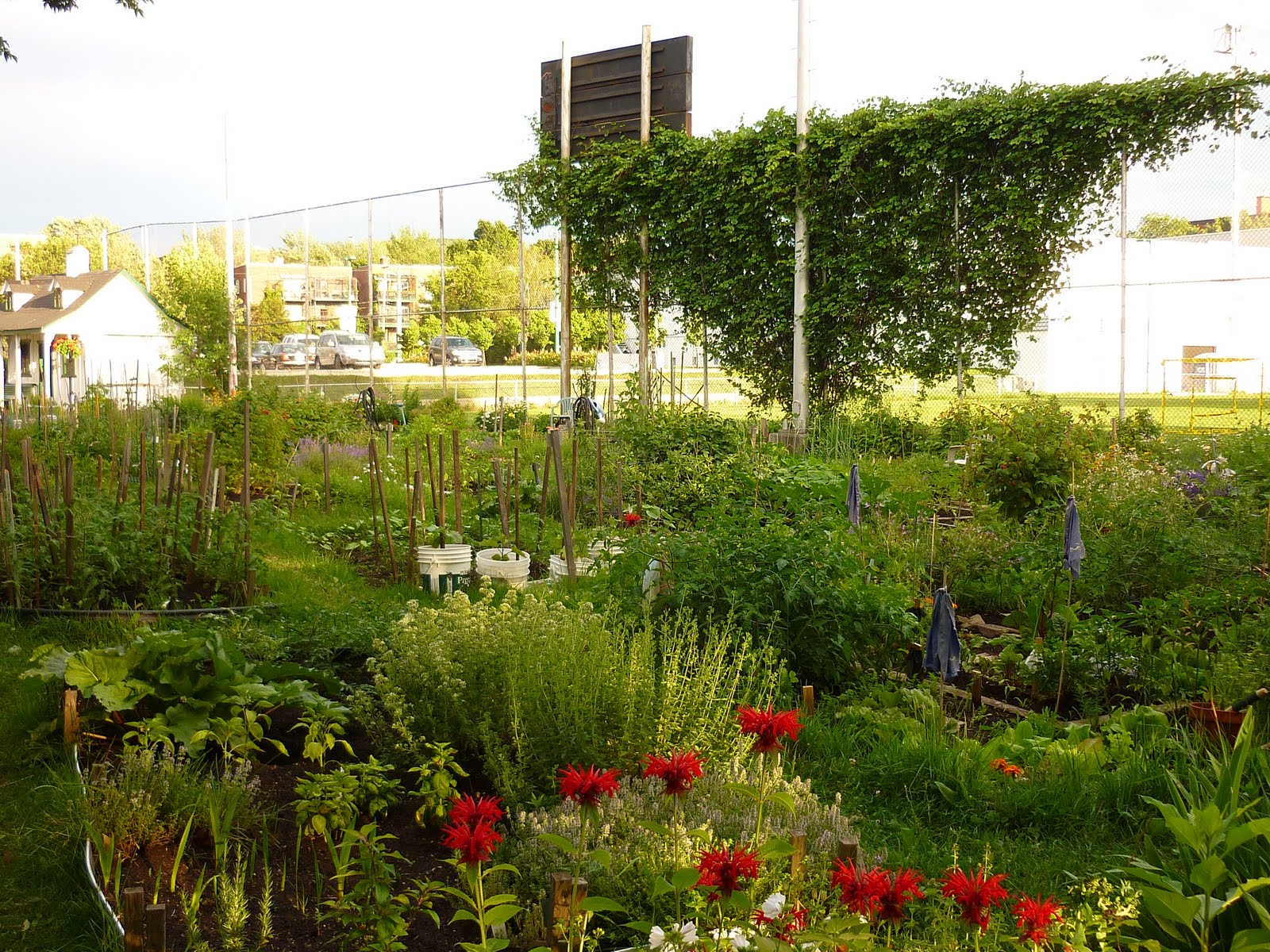
"Community" Garden

Just this week, I heard something I had been dreading: more evidence that the community garden where I have my little patch of Eden (left) will be erased to make room for condos - large numbers of sterile, green-hating condos.
I have to get my hands on the documents (or the ones allowed into the public eye - I doubt everything will be available, she mutters cynically) before I can do anything, such as draft a protest letter, citing environmental impact, etc. But I am already discouraged by talk (with fellow gardeners) of the strict and blind adherence to ye olde Bottom Line exhibited by the city council. In order to attract more wealthy tax payers to the area, they will wipe out a large area of useful green space (not a vacant lot), and take with it the place where people like me find solace and a bit of actual sustenance, and where many young people congregate to play baseball in the nearby field. That will all be gone next year or the year after. I asked my informant whether there is any chance of swaying the council with an angry protest from the lot of us, and she said that the gardeners and local neighbors (who benefit from green space, and would suffer from increased traffic) are generally resigned to the fact that the council only thinks of money and will not engage in democratic discourse. Defeated before we begin.
Everyone - whether truly busy (see "Insidious Busyness" below) or gifted with ample time, such as many retirees - has been conditioned by big business to be an individual first, and later (if ever) part of a community.
The system is self-perpetuating, even without veering into illegal or unethical behavior. 
What do we do about it?
Stay tuned. I ain't finished with these self-serving, life-negating, community-blind fascists with dollar signs for eyes just yet.

Sunday, June 27, 2010

Nostalgia

While cleaning out a closet last week, my mother came upon a cache of my old stuff. I went through a pile of it yesterday, and what stood out most were the letters - about 30 of them, all from the same period in my life.
There was a time when I would have a bundle of letters and postcards (plus copies of some of my own letters) as thick as a loaf of bread by the end of every year. (Now I'm lucky to have three letters per year!) Over maybe 15 years of corresponding with this one or that one, I had an average of five steady correspondents per year. Other people would write only when on vacation, and yet others would drop a line once in a blue moon (and usually, but not always, apologize profusely for the gap). With long-distance rates being so high then, it was the main way to keep in touch over the summer, or after someone moved away.
I have made every effort to save these letters. However, due to many moves, some of these bundles have gone astray. The pile my mother just found was from my teens and early twenties. So the majority of the letters came from classmates between Grade 8 and early university - a very turbulent and highly charged time in anyone's life, let alone that of a sensitive person such as myself or any of the people I tended to hang out with. I was inundated with nostalgia as I read those handwritten letters last night. It was mostly a pleasant experience: happy memories of good people, plus sadness over days gone by. Several things came to mind as I leafed through the pile.
  1. How often, and emotionally, even notoriously taciturn male friends wrote to me! Since some are still in my life to whatever extent is possible (?), I can compare, say, a young Michael or Paul with the middle-aged one. Sad to say, they are very much the same in some respects, but not in an emotionally revealing one. Perhaps life has taught them to be more closed and circumspect.
  2. How valuable a handwritten letter can be - and not just because even the simplest message from a friend says "I'm thinking of you and wish we could be talking in the same room instead." The paper is tangible - a sensual detail. The handwriting reveals character - and you don't have to be trained in graphology to find it useful. The words can also be compared or contrasted with the handwriting - e.g., a cheery letter scribbled in an erratic hand might suggest a friend is hiding anxiety or illness. 
  3. How electronic mail, great boon to keeping in touch across the globe that it is, has all but rendered letter writing obsolete. I feel sorry for the young people who have grown up with instant communication through electronic devices and have few if any records of these often banal but occasionally precious exchanges. And what they do have is printed out from a screen - not scribbled in one friend's fountain pen ink, or another's warm slant (with the drawings of fairies at the bottom of the page presaging her future career as an artist).
To all of you who wrote to me back then - Dale, Belinda, Claude, Paul, Michael, Sandy, Mary, Brad, Lucie, Marie-Hélène, Malcolm, Margaret - thank you for writing to me and doing so with feeling. I am not going to throw out your letters and postcards for a long time, if ever!
Everyone: buy some paper and stamps, and send someone special a short letter! Won't finding a reply in your mailbox be worth a hundred e-mails?
More than ever, it will show you mean to connect, not just pass on information.

Wednesday, June 16, 2010

Why Are Men Smarter than Women?

I was listening to a Guardian podcast on genius when it occurred to me why more men get credited with advancing society, leading most men and lots of women, incidentally, to believe that men are smarter than women. A lot of it has to do with the differences between male brains and female brains, and what society expects of each sex.
(Men also have been doing a very good job of holding back society - through wars, various kinds of harmful dogma, self-serving beliefs and practices - but that's another post perhaps. This "paradox" supports a recent observation that men tend to occupy the extremes of good and bad, while women occupy more of the middle ground.)

Genius is a complex phenomenon, and often identified only in hindsight. A quirky little boy or girl with strange ideas and perspectives will probably be noticed for being different, but not valued for his or her individual outlook unless it yields a discovery, invention, remarkable work of art, or the like. In other words, if you're going to stand out, you have to earn acceptance more than the average person!
Not every genius with the potential for that breakthrough ticket to public acceptance and even adoration finds the right opportunities to shine. We'll never know how many Marie Curies, Isadora Duncans and Virginia Woolfs died in childbirth or toiling in a field - not to mention the Mozarts, Newtons, and Picassos coughing away in attics unable to find the money for basic materials.
To get to that invention or symphony, a person needs talent and opportunity, no doubt about that. But personality - mainly, determination and belief in oneself and one's work - probably separates the sheep from the goats most of all.
That's where male-female brain differences - and how society boldfaces them - come in. Men in general have a greater ability to take a project and focus on it to the exclusion of everything else. The modern cliché of the unkempt computer nerd has historical precedents in the mad scientist or long-haired crazy composer. Men are also more likely to be collectors (another form of monomania). Women are better multitaskers and generalists. While shallow thinking and attention combined with a talent for forming connections can have brilliant results, they do not tend to translate into works of genius. Gregor Mendel grew hundred of pea plants before he was able to discern the patterns of trait inheritance later called genetics. Not only was he incredibly patient and focussed and smart, he was a monk with no other job, no bills to pay, no kids to run after! If a woman did something similar, she'd be called an oddball for opting out of her "true role" as a wife and mother.
If men discover more, change more, it may be because they use their intelligence for deep focus - and tend to find support in family and community for doing so. They also may be more singleminded when it comes to pursuing a socially peripheral project that they alone find worthy; women tend to listen to criticism more.
Things are changing a little. Women with the ability to devote long hours in the lab or at the writing desk are scorned far less than they used to be, and the opportunities needed to advance (money, education, support) are more abundant in many parts of the world. But the female need to form interpersonal connections (and be praised for the ones she does form) may preclude the creation of those really big breakthroughs - the ones that make it into the history books, even if most tend to be written by men.

Sunday, June 13, 2010

Crushed Empathy

Hard to read in parts (I skipped them, I'm not ashamed to admit) but superb and well overdue in a national paper is this New York Times article on the connection between violence towards animals and violent, unempathetic behavior in general.
Finally, forensics labs and law enforcement agencies across the U.S. are making this long-obvious link (what's Canada doing?). Many serial killers were later found to have tortured local pets, and many family abusers have been animal abusers - it's all about a lack of sensitivity to the pain of others, worn down by abuse they endured themselves (directly by adults or by their impoverished and dangerous environment). It is also, of course, about power and control. If you feel the boot-heel of the universe is grinding your face everyday - to paraphrase Orwell - then you will try to hold yourself together by hurting the nearest convenient target: say, a puppy or a toddler. Mental health depends on having a degree of control over one's life. Tragically, violence against weaker beings is the only control available to some people.
Randall Lockwood is at the A.S.P.C.A.'s forensics department.
Along with possible early abuse or genetic and biological components, Lockwood also spoke of the frequent association between environment and acts of violence, how poverty often creates the sense of persecution and injustice that makes some people feel justified in striking back in order to gain the sense of power and control they otherwise lack.  
Nobody in their right mind needs to be told that severe conditions (neglect, abuse, hunger, toxic and understimulating surroundings) tend to give rise to severe children. But it seems to be one of those items of common knowledge that no one wants to admit - if admitting means addressing it and fixing it. It means admitting to horrible living conditions in otherwise rich cities. It means admitting systemic cracks in certain cultures within cultures. For example, many poor boys join gangs because they have no fathers around to give them direction, no job prospects, and often no one to love them or accept them except gang members. But gang membership is a cruel kind of acceptance, involving the crushing of any innate empathy - as empathy is equated with weakness.
The brain is a highly plastic organ, ready to adapt to whatever environment it finds itself in. It doesn't always adapt in a way conducive to the greater good.
No child is an island: whatever stunts his growth, stunts the entire community. And the companion animals we bring into our homes are part of that community, too. We ignore their abuse at their peril and our own.

Thursday, June 10, 2010

The Power of Music

My favorite band in the world is Arcade Fire. Got to see them in a concert in 2007 - standing room only. Amazing show, if a bit hard on the legs and back. Last night, after I heard of one of their famous "secret" freebie shows, I saw them again. Yep, had to stand (more than two and a half hours in all) but it was definitely worth it.
I won't go into raptures about the band - they hardly need my praise, given their worldwide adoration by fans and fellow musicians (e.g., David Bowie). The totality of the experience is what remains with me.
First, there was the anticipation: when I finally got to the outdoor spot, saw the stage set up and fans gathering, I knew I was in for a treat. Then there was the show itself, which began spot on 8:00 and lasted as long as a paid concert - about 90 min. Wow. There were about four songs from the latest album, several from the first, and not enough (IMO) from the second. The band members' enthusiasm was electrifying. Win Butler, the lead singer and songwriter, said he was truly overwhelmed by the turnout (more than 5,000!). "And I'm not shitting you," he added. I've never seen him so happy.
The music, some of it familiar, some of it new and exciting, made me forget about the past month for a few hours. I was filled with the power of music - and by the power of a shared experience. I admit I taped several performances (for my own record), and when I played them back, I actually enjoyed seeing hands waving, fists punching the air with joy, and rhythmic clapping. The crowd was part of my "forgetfulness" for sure.
We connected over a shared emotion, and we temporarily lost our sometimes proud, sometimes narrow, individualism.

Thursday, June 3, 2010

Burial

On May 29, exactly three weeks after he died, we buried Pablo here.
Not under this tree, but almost opposite it. I did not feel right about recording any other aspect of the operation.
My friend, whose property this is in the southeastern part of Ontario, did all the heavy lifting - literally and figuratively. I am deeply grateful.
Burial means different things to different people. Closure. Return to the soil. Memorial spot. Something physical in a spiritual realm.
For me, burying my dear cat was mostly a way of staying true to my beliefs (as it would be, in very different ways, to others) - namely, honouring the cycle of life. I wanted him returned to the cycle, and my friend did us the supreme honour of allowing us to put Pablo in his soil. It certainly helped that the place we chose was beautiful. Of course, a dead cat, like a dead human, cannot know the difference between a gorgeous spot and a landfill - when you're dead, you're dead - but since there seems to be a deeply human instinct against desecrating a body, placing it somewhere lovely is the final dignity we can show the loved one. It made me feel a little better.
(I suppose part of that instinct is highly personal: we would not like to think of our dead body being tossed to the vultures or dumped like trash somewhere, even though - again - once you're dead, you feel nothing.)
This is not the only burial I have experienced lately. The only way I can get back into my routine is to bury my feelings. Now and then, I allow them to resurface, and the pain is as strong as ever. I allowed myself to be deeply connected to that animal, and the loss is terrible.
I see this as some kind of rehearsal for losing a member of my own species one day, one who means as much or more to me as Pablo. I don't think I will be quite as successful with the burial of that grief.

Monday, May 24, 2010

Fairy Tales and Social Regulation

On Saturday, I went to see an amazing example of the latest technology in film restoration. Thanks to bigwigs like Martin Scorcese, a true film classic, The Red Shoes, is now available to a new generation of film buffs.
The Red Shoes is probably the ultimate ballet movie, and maybe the ultimate art movie. Not only is there a great story - lifted from the fairy tale by Hans Christian Anderson - but it features surprisingly deep character development, so we really get an idea of what it's like to run a dance troop, audition before a megalomaniac producer, and find fulfillment in one's art form. (When is the last time you felt a movie explored character like a novel? Only when you see a golden oldie do you see how satisfying it is to watch. Sometimes it's easy to think modern film consists of special effects with a few people thrown in. But I digress.)
The original fairy tale is a variation on the Faustian bargain. Faust agrees to sell his soul to the devil in exchange for worldly ambitions. The dancer in "The Red Shoes" never encounters the devil, but he is there in spirit: giving her fame through he power of the red shoes, at the cost of love, and then her life.
Victoria Page, in the story about the story, dares to be ordinary: she loves a man and marries him, neglecting her art. The megalomaniac insists she return to her art, renounce her husband, and achieve greatness. The choice literally sends her over the edge.
The lesson or moral of so many fairy tales is so remember the social contract and not to allow self-interest (set in place by the will to survive) to take up too much energy and focus. Kindness is rewarded. Selfishness and excess ambition are punished. These tales were probably written to instill social values in children (through benign subterfuge, except in particularly gory stories - and there are no shortage of those!). Yet they were also entertaining and immensely satisfying to adults - mirroring their sense of justice and fair play.
These days, we still desire social regulation, but the way we tend to go about it can be frightening. Modern Faust stories usually involve women being punished for choosing ambition (or even too much energy on an ideal) over relationships. (Men are rarely if ever chastised for the same - because they are still defined by work, not connections to others.) On the scarier end, we have Hollywood movies featuring vigilante justice: men going outside the law to exact revenge on criminals.
Can you think of any classic fairy tale with such an obvious message as "The Red Shoes"?

Wednesday, May 12, 2010

Nibbling with the Eyes (or Ears)

Part of my grief over the loss of my little friend is due to the abrupt change in habit. Being able to be close to Pablo several times a day produced oxytocin in my brain - a neurotransmitter known to counteract stress. (No wonder pet therapy is a growing concern.) Oxytocin is most strongly produced between mother and child, but can appear in other loving exchanges. Pablo was a very touchy-feely feline - unlike other very sweet cats I have known over the years. How I miss his big, velvety paws!
Late last year, a series of fortunate accidents brought books on social isolation to my attention, including Loneliness, by John Cacioppo. One of the things he mentions in that book is something called "social snacking." In lieu of actual contact (a "meal") with a loved one, people e-mail, call, text, and gaze at photographs.
Yesterday, when I had a friend over, I showed her several years of Pablo photographs. To my surprise, it gave me solace, not pain, to see him in all those poses. I realize now I was nibbling to keep from starving. His beauty - and, if I may be immodest, my skill as a photographer - was very gratifying. I remembered how lucky I was to have that handsome animal in my life.
Today, I found this Guardian article on long-distance consolation. Seems just hearing the sound of your mother's voice can lower stress hormones (cortisol) and raise oxytocin!
The need for connection is so great, we evolved back-up measures. Reach out and touch somebody, indeed.